

The Long Way to Alpha
A closed summit, a collapsing Plan B, and the long way around Serratus to one of the best corn runs in the Sea to Sky.
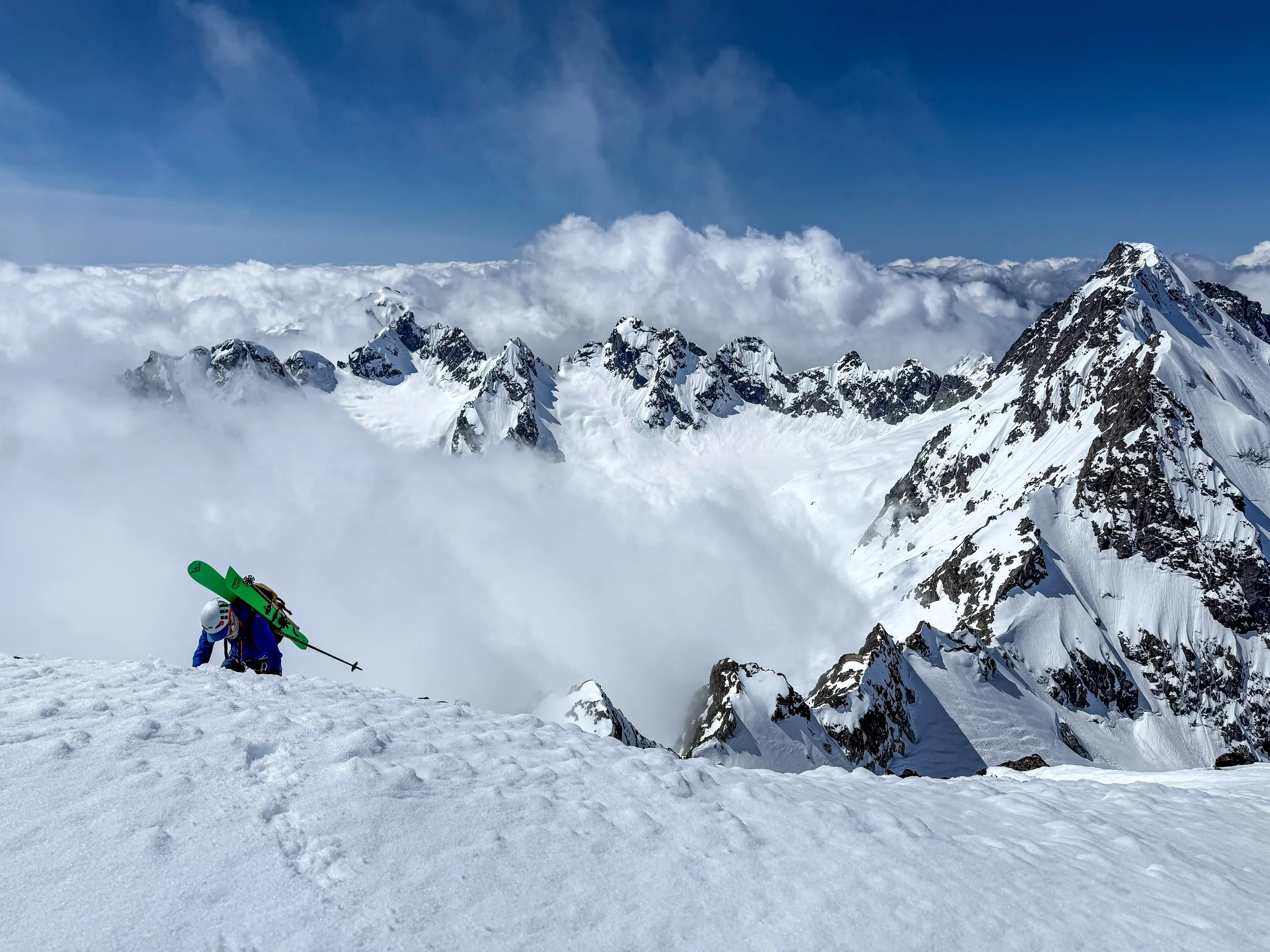
I am awake at 5:30 most mornings, but that morning I was up before the alarm. After two days of weather, and with a big ski day waiting outside the Jim Haberl Hut, my mind was already running ahead through every transition, climb and exposed turn that had not happened yet.
Alpha had been one of our main objectives for the week. Alexis and I had already summited and skied Serratus, but the south face of Alpha was the line we kept looking toward. The forecast had finally given us a window. By seven we were fed, packed and standing outside the hut with our skis on.
The range was floating above an inversion. Peaks rose from a sea of cloud, the sky overhead was clear, and for a moment the day looked exactly as we had hoped. Then we looked at Alpha.
A cloud was pinned to the summit and tearing across it fast enough that we could see the wind from where we stood. Alexis and I looked at one another. We had not even left the hut, and Plan A was already gone.
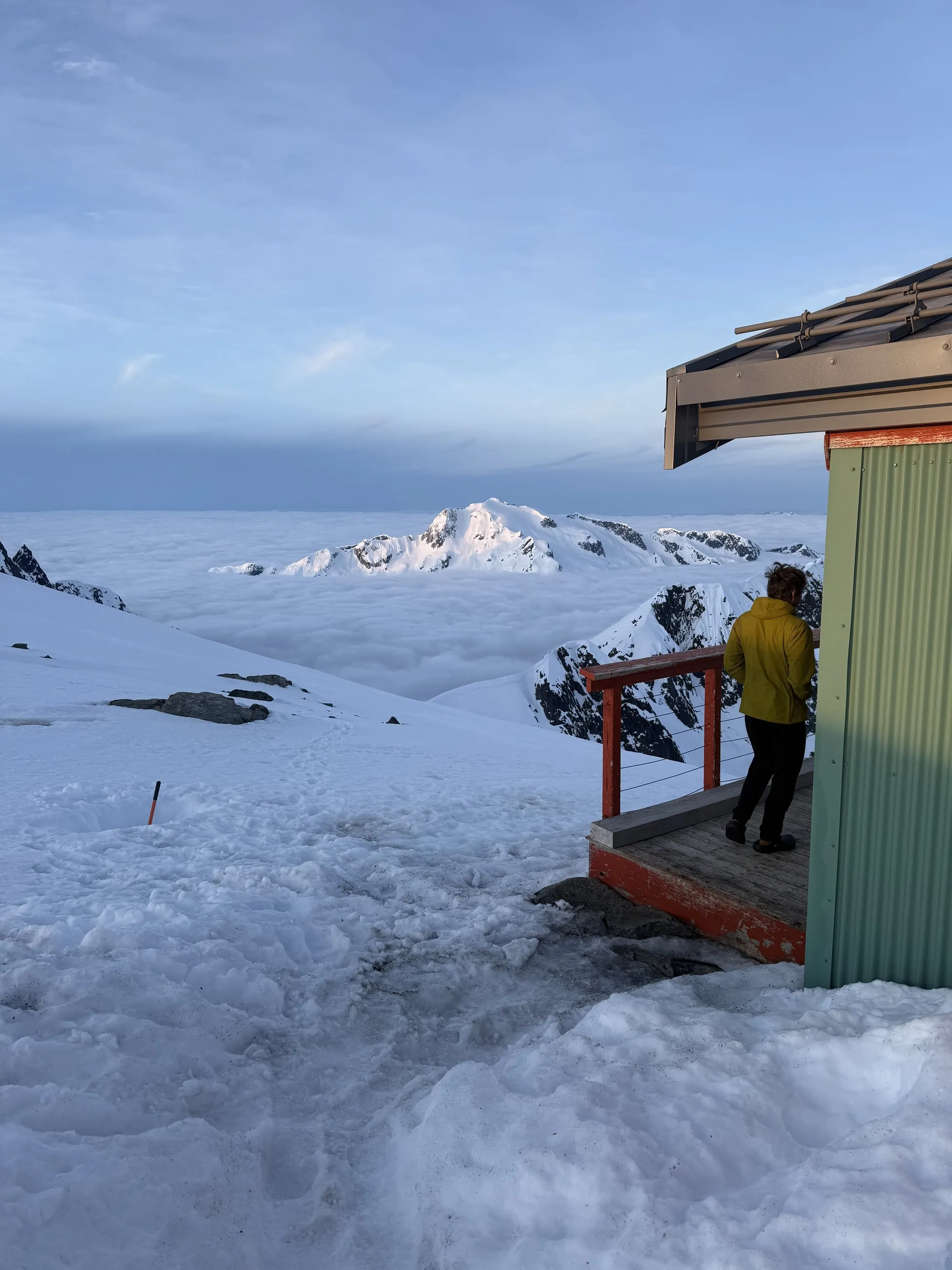
The other side of Serratus
Before leaving Squamish, a friend who had spent time in the Tantalus earlier in the season had suggested the south-facing terrain near Ionia. Neither Alexis nor I had been there, but it offered a way to use the weather window without committing to the wind on Alpha.
We changed plans and started up toward Mini Serratus, a common heli-ski run above the hut. From its base we would traverse around the west side of Serratus, cross the terrain used by the Tantalus Traverse, drop into the Lake Lovely Water basin and work across the high bench toward Ionia.
On paper, the first leg was a gentle descending traverse. In reality, it was frozen solid and littered with avalanche debris and death cookies. Below us, the slope rolled into large cliffs. A ski coming off would have been consequential in the most literal sense.
We moved carefully, edges scraping, trying to absorb every frozen block without being knocked off line. After several tense sections we reached the col and booted the last short pitch to our first real descent of the day.
What waited on the other side was some of the worst snow I skied all season. The face had been raked by avalanche runnels and had not softened evenly. One turn would land on boilerplate hard enough to bounce a bowling ball; the next would break through into soft snow. Every jump turn was a small guess about which surface would catch the skis.
Once we reached the bench, the angle eased and the day briefly became beautiful again. We pointed the skis across the hanging terrain and glided toward the slopes below Ionia.
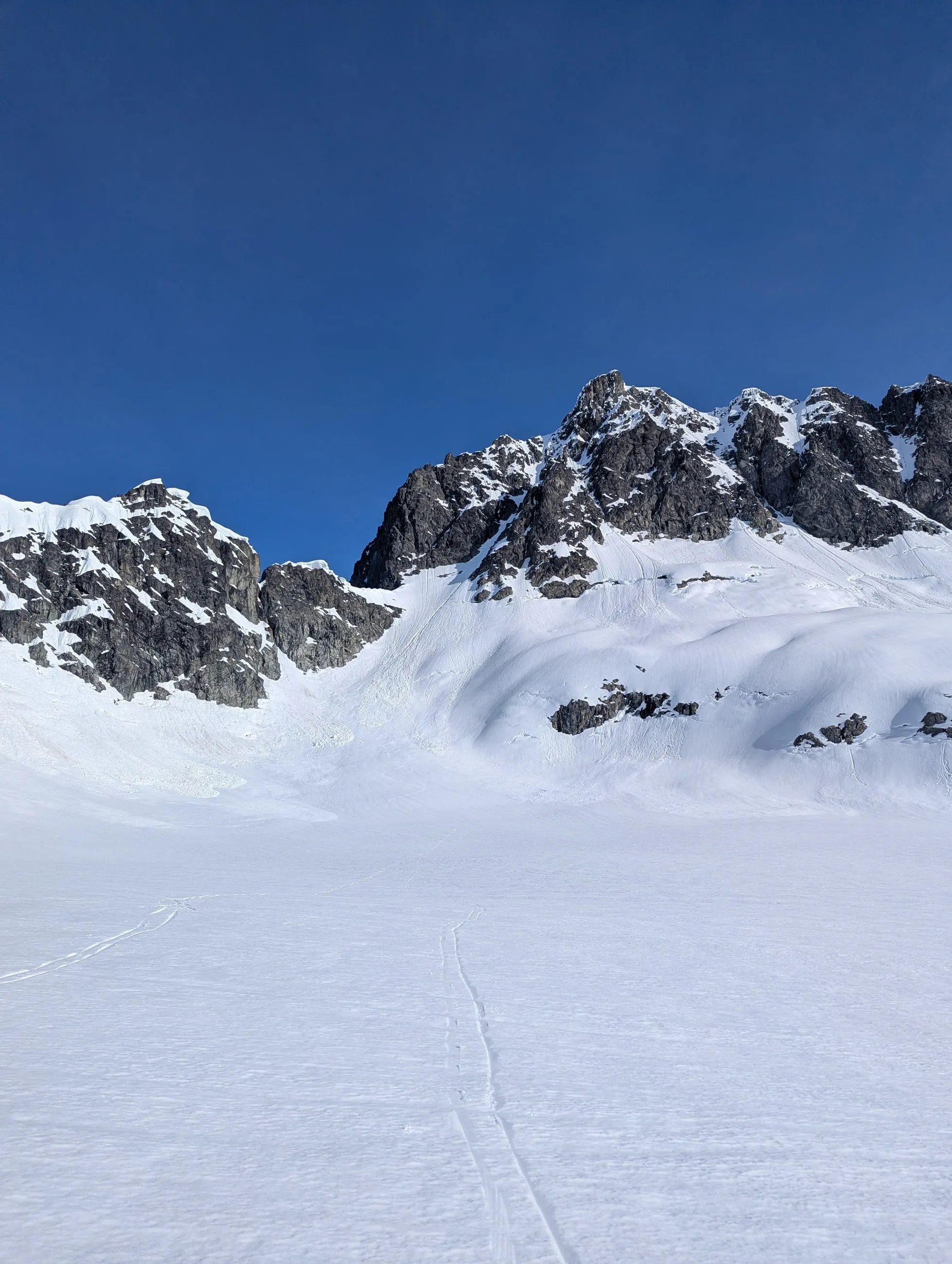
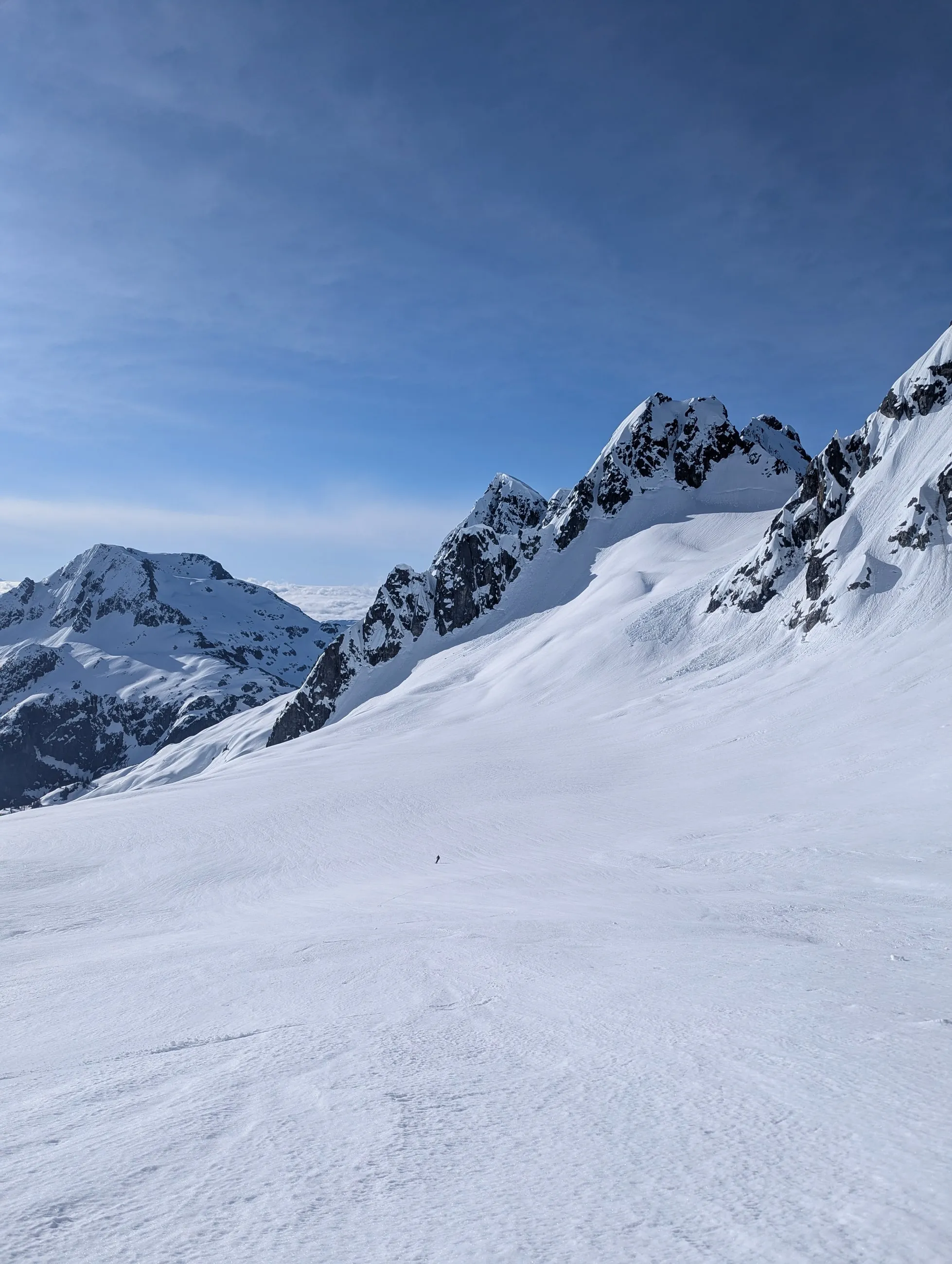
We stopped at the far side and began getting ready to put our skins on. Before we could, a deep rumble came from above. A large wet slide released from Ionia and ran onto the slopes we had planned to ski.
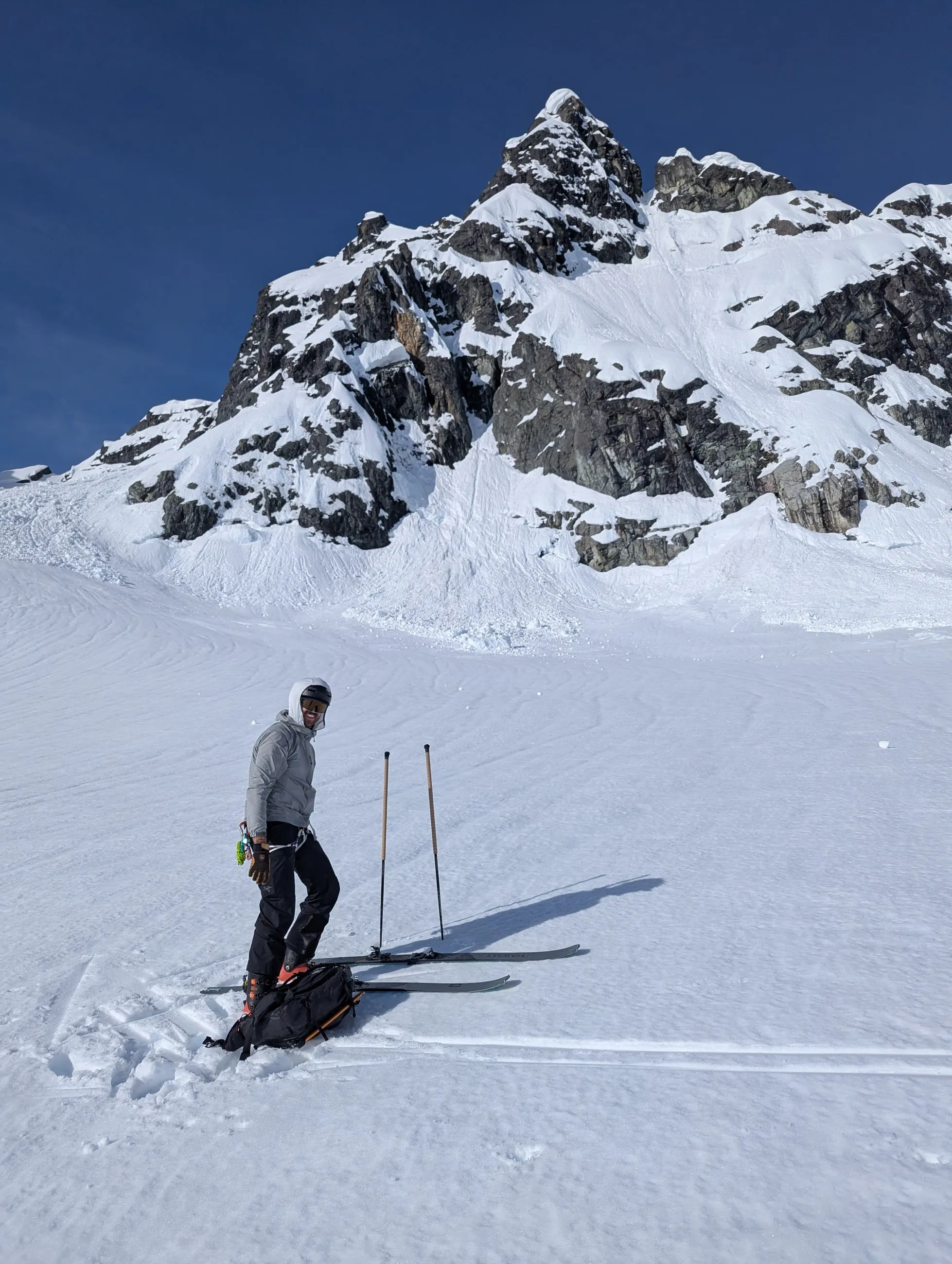
I am not especially superstitious, but I do believe in listening when a mountain makes its answer obvious. The slope had gone through its first major warming of the day and would only get hotter. Ionia was closed.
Then we looked back at Alpha. The summit cloud was gone.
The way out
It felt like one door had shut and another had opened, but getting from one to the other was the problem. We could not simply climb back up the frozen, runnelled slope we had just descended. Our viable exit was to traverse the bench beneath Serratus toward the Alpha–Serratus col.
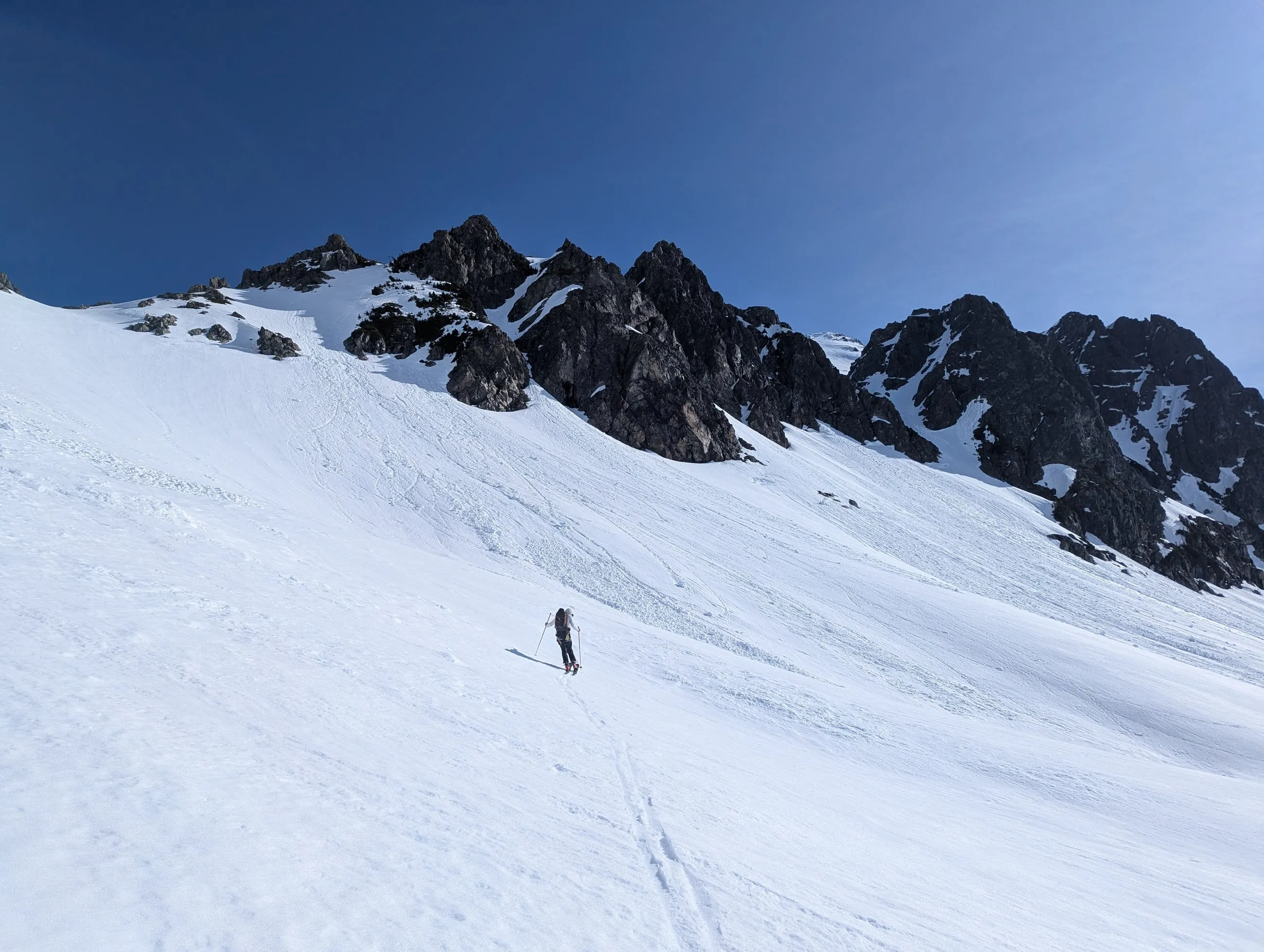
We skied as far as gravity allowed, put on our skins and began the rising traverse. The supportive crust gradually gave way to soft, warming snow. Above us, several avalanche gullies and broad patches of hang fire sat in direct sun. The terrain that had looked like a pleasant bench from a distance now felt like a trap.
Near the far side, the traverse steepened into a short bootpack out of the final gully. Halfway up, another rumble rolled across the basin. An avalanche had released several gullies away.
Alexis and I did not say anything. We looked at one another and started climbing as fast as we could.
The next few minutes were pure effort: kick, step, breathe, repeat, with no spare attention for anything except reaching the lower-angle terrain above. Once there, we snapped into our skis and moved sideways out of the overhead hazard before stopping to let the adrenaline settle.
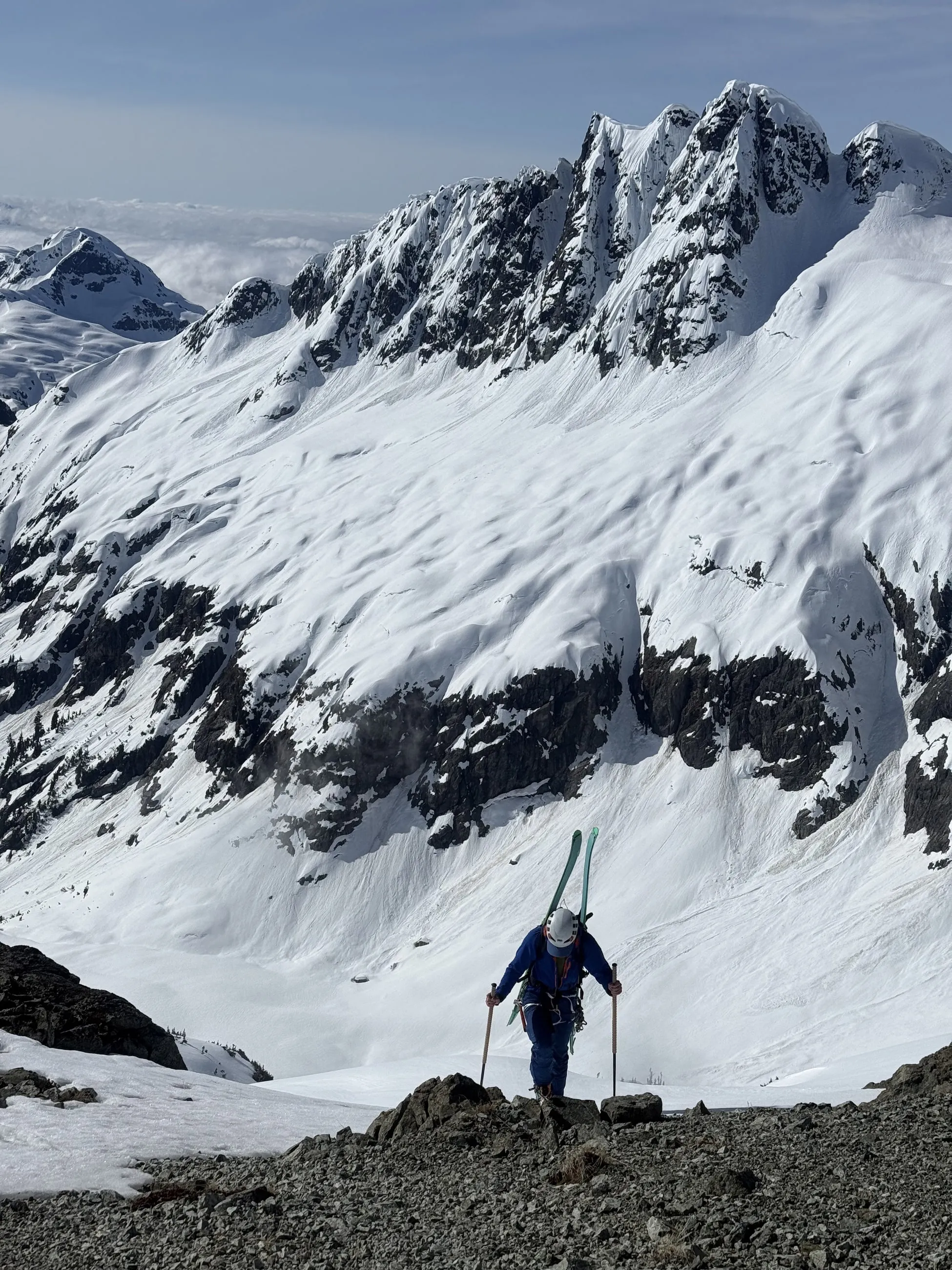
From that safe ground, the skin track to the Alpha–Serratus col was almost peaceful. The crest gave us our first real pause of the day, with peaks rising above the inversion in every direction. We ate, drank and studied the next problem.
Across the gap
A large wind lip guarded the south side of the col. Skiing it appeared to require one committed turn above a cliff roughly fifteen metres high. After the variable crust we had already encountered, neither of us wanted to discover the landing surface halfway through that turn.
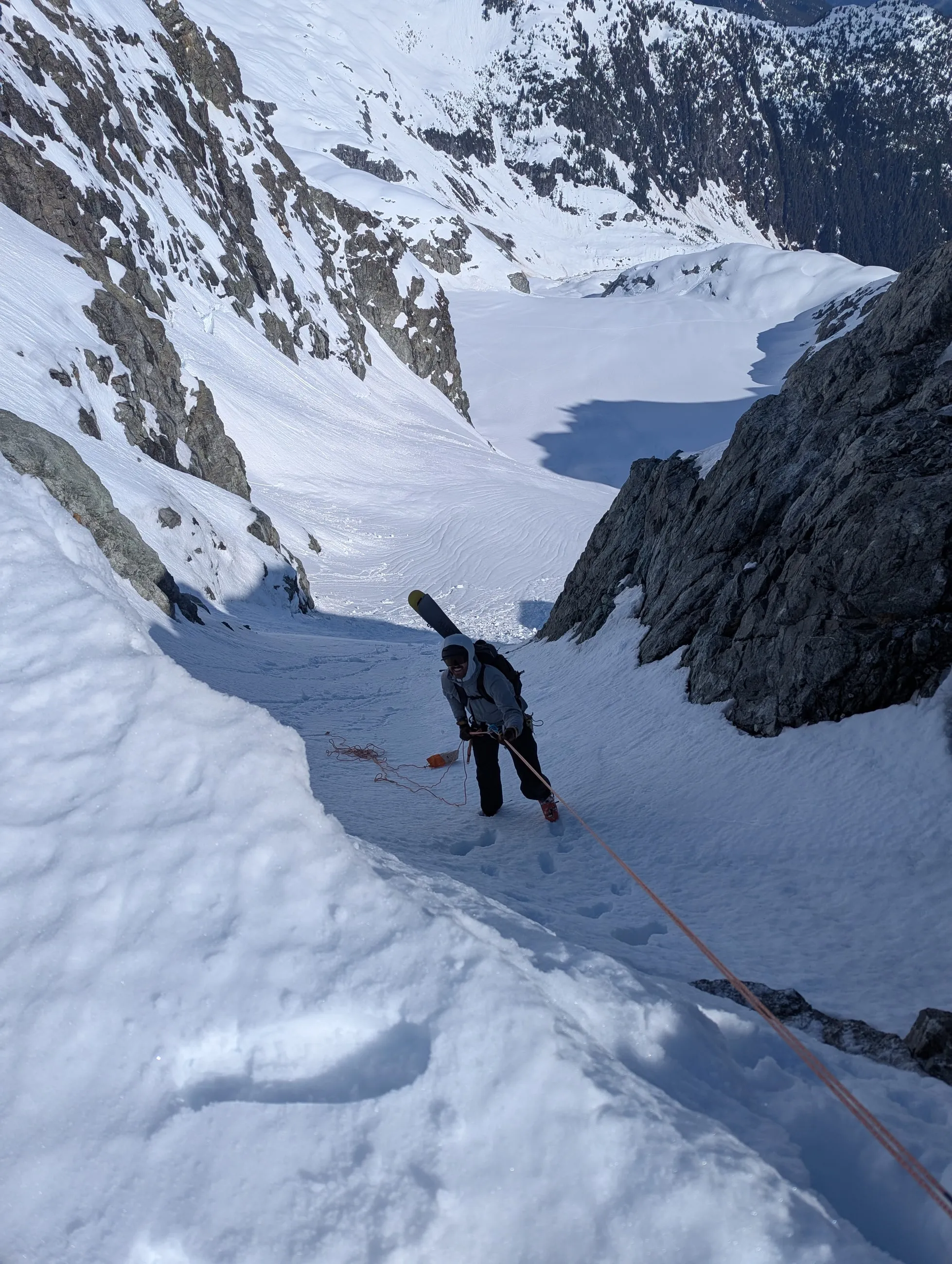
We slung a rock block and rappelled instead. Alexis went first, then started downclimbing with his axes while I followed. As I reached the bottom of the rope, he called up. He had punched into the bergschrund to his legs, but managed to climb back out.
There were no obvious gear placements for protecting a crossing. We put on our skis, built a little speed and crossed the bergschrund diagonally, trying to spread our weight and spend as little time over the gap as possible. It was inelegant, stressful and effective.
Beyond the bergschrund, a mellow skin brought us below the proper south face. We stopped again, ate, drank, put the skis on our packs and took out two tools each.
The lower face was firm but straightforward. Higher up, we moved into a shaded groove where the snow had become hard alpine ice. Instead of plunging my tools as I would in normal spring snow, I was swinging them. With Alexis behind me, I tried to kick steps large enough to give him something secure to follow.
For the next hour, the climb narrowed into a rhythm: hand, hand, foot, foot. The surface changed constantly. Sometimes a boot punched through the crust; sometimes it landed on ice that would not yield at all. The repetition made the uncertainty manageable.
Near the top, rather than skirt left onto the easier snow, we stayed right and threaded between rock outcrops. The climbing was more interesting there, and after everything required to reach the face, it felt good to choose difficulty for fun rather than have it imposed on us.
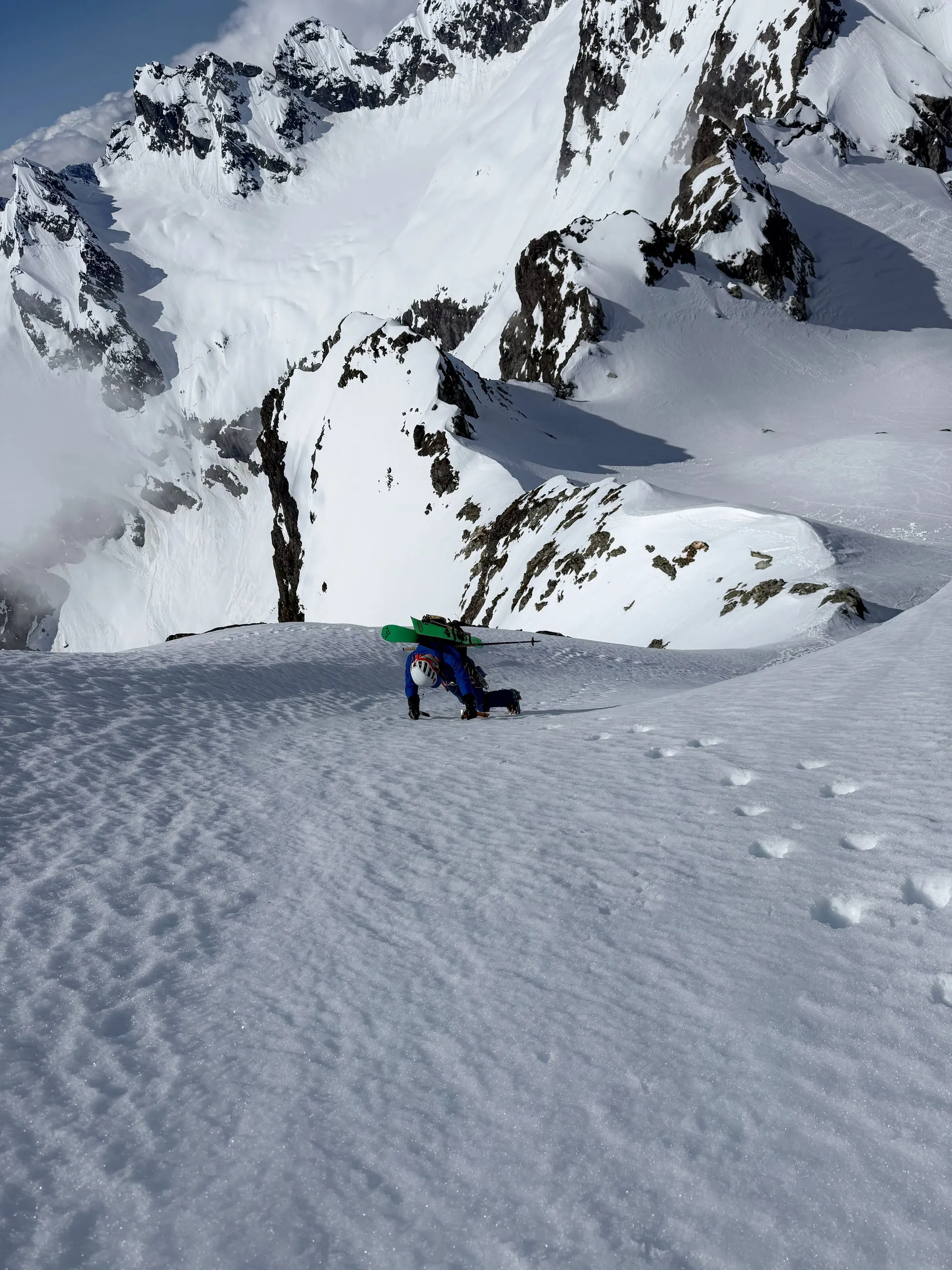
I crested the summit and waited with my camera as Alexis climbed the final steps. We had made it to the objective we abandoned before leaving the hut, by travelling almost all the way around Serratus to get there.
The south face
Summits often make me anxious. The upward problem is finished, but the descent is still abstract, and every line looks more complicated from above. This time, rock outcrops guarded the first open turns. I picked out a passage to skier’s right and told Alexis I thought we could ski from the top without taking our skis off.
As usual, the anxiety disappeared after the first two turns. I was no longer studying the descent. I was skiing it.
The reputation of Alpha’s south face was well earned. After a morning of boilerplate, breakable crust and avalanche runnels, the snow was perfect corn. We skied the upper headwall in one pitch, regrouped, then dropped the lower chute. Every turn held. Nothing punched through. For the first time all day, there was no puzzle hiding under the next patch of snow. We did not stop for photos. After the morning we had, the skiing was too good to interrupt.
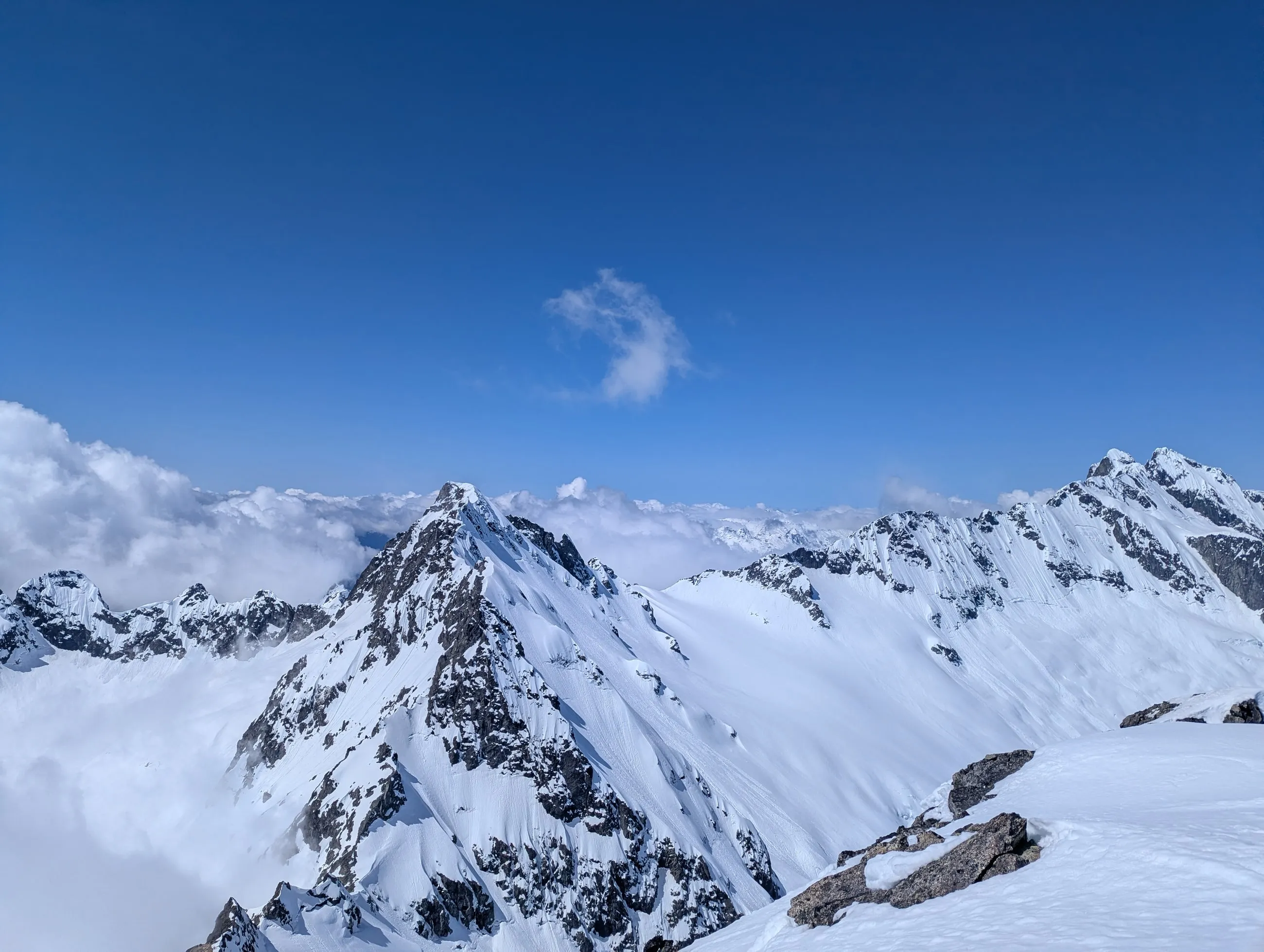
At the morainal lake below, the remaining work was simple but long: regain the glacier and climb all the way back to the col by the hut. One short bootpack crossed sun-affected south and southeast-facing slopes that were becoming isothermal. We moved quickly, reached the glacier and settled into the final skin knowing that cocktails were waiting at the hut.
Reflections on the day
The south face of Alpha was one of the crown jewels of my 2026 ski season. It was also a day that deserves an honest accounting.
Committing to unfamiliar terrain in the Lake Lovely Water basin without fully understanding the exits left us boxed in once we descended from the Serratus–Ionia col. Had we continued onto Ionia and skied there late in the day, our safest option might have been to wait for an evening refreeze before trying to return. We carried enough layers to endure that, but it would have put us in a compromised position that we had not planned for.
The clearest lesson was how much time we spent beneath warming south-facing slopes. In an isothermal cycle, the clock was everything. Our detour meant we reached the traverse toward the Alpha–Serratus col after the slopes overhead had already begun shedding. The second release made that exposure impossible to ignore. If I were to repeat any version of the day, I would either start much earlier and cross while the terrain was still locked up, or not commit to that side of Serratus at all.
Whether the frozen descent into the basin would have been skiable at that earlier hour is another question. The day offered no tidy version in which every slope was ready exactly when we needed it.
That uncertainty is not an excuse. It is the part I want to remember. A successful summit and a classic descent can make the decisions leading to them feel better in hindsight than they were in the moment. The quality of the final turns does not erase how committed we became on the wrong side of Serratus.
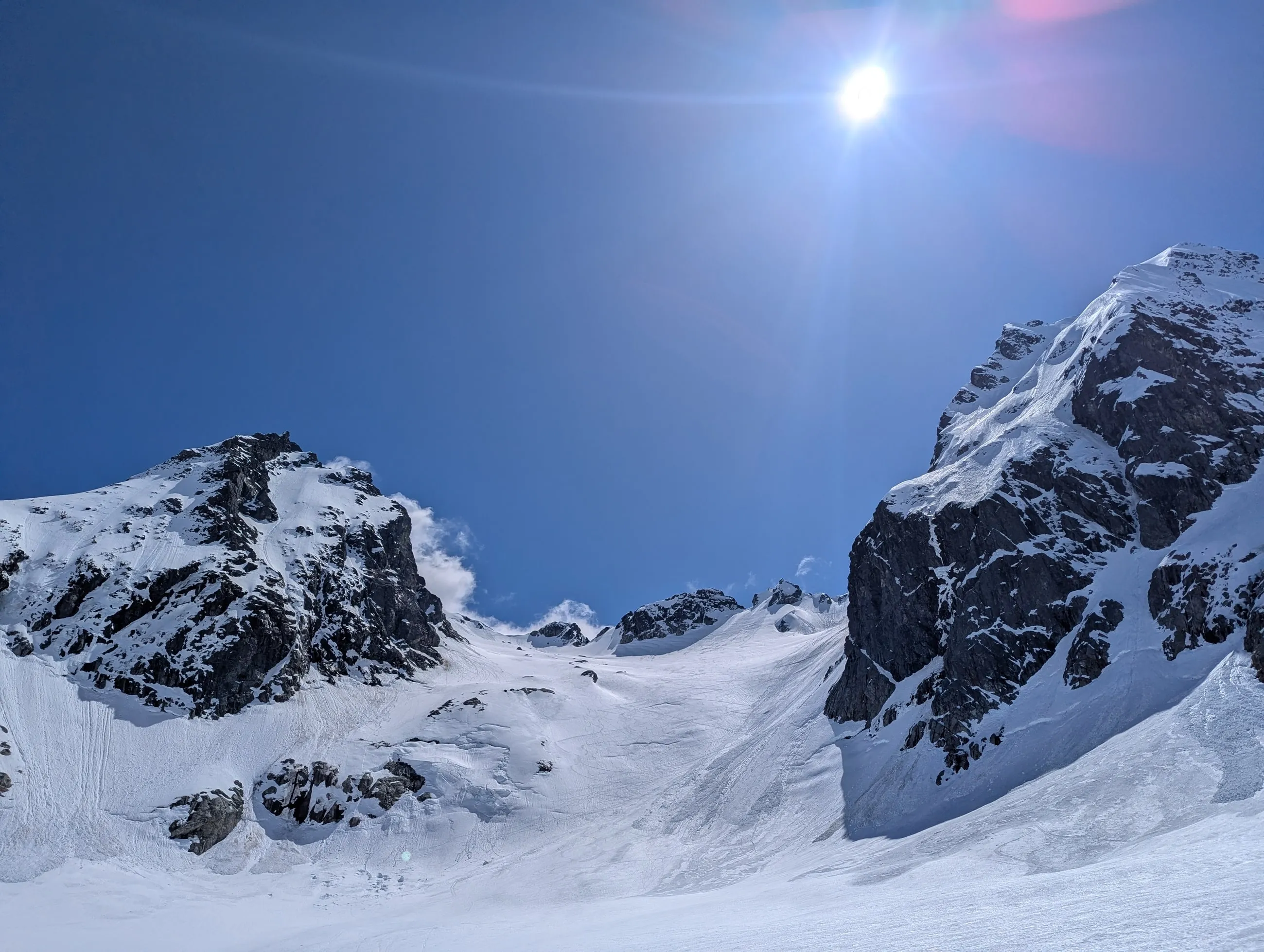
For the rest of the trip, the pressure came off. We had skied Serratus, circumnavigated it and reached the top of Alpha. Soon a helicopter would arrive with more friends and my partner, Linsey, for a weekend of glacier laps and uncomplicated skiing.
After a day that contained more Type 2 fun than either Alexis or I had intended, it was time for some Type 1.