

Samaya Ultra Pace
Samaya Ultra Pace First Look: A 365 g Vest-Style Alpine Pack
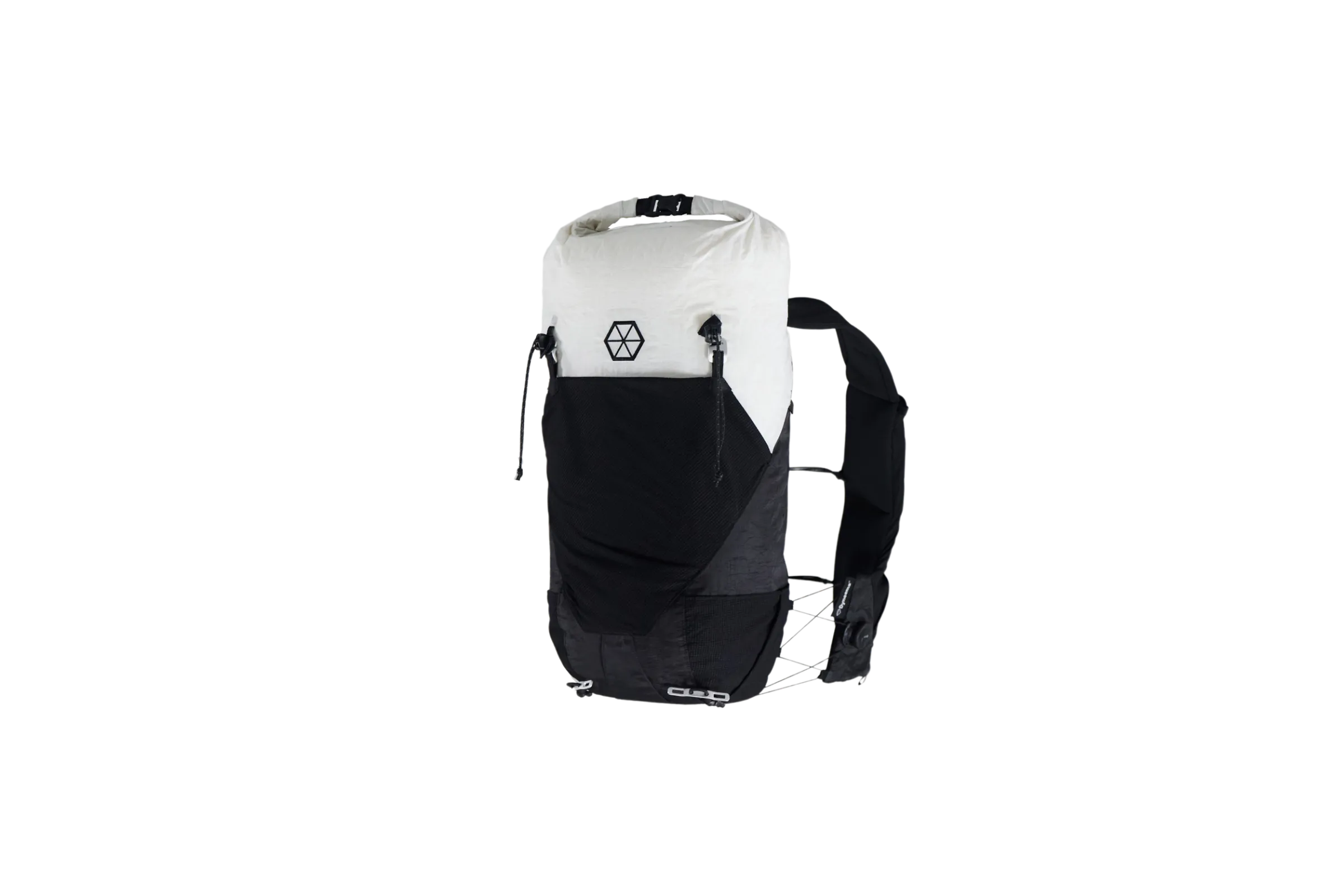
A first look at Samaya’s 365-gram vest-style alpine pack and the questions it needs to answer in technical mountain terrain.
First-look thesis
On paper, the Ultra Pace combines the locked-in feel of a running vest with alpine features that running packs usually leave out. Field testing will determine whether the design remains comfortable, durable, and easy to use under a real climbing load.
- Best for
- Appears best suited to fast, technical days when the pack stays on for most of the climbing
- Conditions
- Planned: Squamish granite, long alpine rock routes, and ski-mountaineering days
- Disclosure
- Purchased with personal funds. Samaya had no editorial input and did not review this article before publication. Product links are not affiliated.
Manufacturer data
At a glance
- Volume
- 20 + 3 L
- Minimum weight
- 365 g S/M · 370 g M/L
- Equipped weight
- 425 g S/M · 430 g M/L
- Dimensions
- 45 × 25 × 18 cm
- Waterproofing
- 20,000 mm · manufacturer-stated waterproof seams
- Main / base fabric
- 50D / 150D Dyneema Composite Fabric Hybrid with woven polyester faces
- Back panel
- Three-layer EVA Ariaprene foam
- Fit range
- S/M 65–90 cm · M/L 85–110 cm circumference at the lowest rib
- Included carries
- Removable ski, ice-tool, and pole attachments
Evaluation criteria
Field test plan
- Climbing stability
- Bounce, sway, helmet clearance, and freedom of movement on technical rock.
- Carry and fit
- Approach comfort, harness integration, dial adjustment, and performance under load.
- Access
- Food, water, layers, and small essentials while moving without removing the pack.
- Alpine versatility
- Ice-tool, pole, ski, and skin carry across summer and winter configurations.
- Durability and weather
- Abrasion, seam integrity, pocket wear, and real-world water resistance over time.
I keep returning to the same thought when climbing with a small pack: a running-vest harness makes sense for fast, technical terrain.
Traditional shoulder straps work well on an approach. Once the climbing becomes three-dimensional, though, a loosely carried pack can shift from side to side, pull away from the back, and feel like a separate object to manage. A running vest does something different. It wraps the load around the torso, holds it close, and moves with the body.
That difference sounds minor until I am high-stepping, squeezing into a corner, or reaching across my body with the pack still on. Then it becomes the point of the design.
The idea started on the Chief
The idea became hard to ignore during a long mission on the Chief in Squamish with a Black Diamond Distance 15. The vest-style fit kept the pack planted, the capacity encouraged an efficient kit, and the pack mostly disappeared while climbing.
Later, I used the same pack on the Beckey–Chouinard on South Howser Tower in the Bugaboos. It was a useful proof of concept: a pack designed for long mountain runs could also work surprisingly well on a long alpine rock route.
“Well enough” was also where the limitation showed. The Distance 15 is fundamentally a mountain-running pack. It can cross over into climbing, but it was not built around the full set of alpine problems: carrying skis, attaching ice tools, managing skins, protecting equipment from sustained weather, and surviving regular contact with rock. Fifteen litres can also become restrictive when the objective asks for a rope, rack, insulation, or winter equipment.
I have seen other climbers around Squamish make the same crossover with running packs. The Ultra Pace is interesting because it approaches that use as the starting point rather than an improvised secondary purpose.
What Samaya has built
Samaya describes the Ultra Pace as an alpine pack for moving efficiently in technical mountain terrain. It combines a vest harness with a 20 + 3-litre roll-top body, removable alpine carries, and a manufacturer-stated waterproof construction.
The main body uses 50D Dyneema Composite Fabric Hybrid, while the base uses a 150D version. Both use a woven polyester face intended to improve abrasion resistance over standard DCF. Samaya rates the construction to 20,000 mm and describes all seams as waterproof. Those are manufacturer claims; keeping contents dry in rain and wet snow remains part of the field test.
The S/M has a claimed minimum weight of 365 grams and an equipped weight of 425 grams. The M/L figures are 370 and 430 grams. The removable equipment includes ski, ice-tool, and pole attachments. Five external stretch pockets and an internal pocket handle smaller items, although the soft flasks shown in Samaya’s product photography are not included.
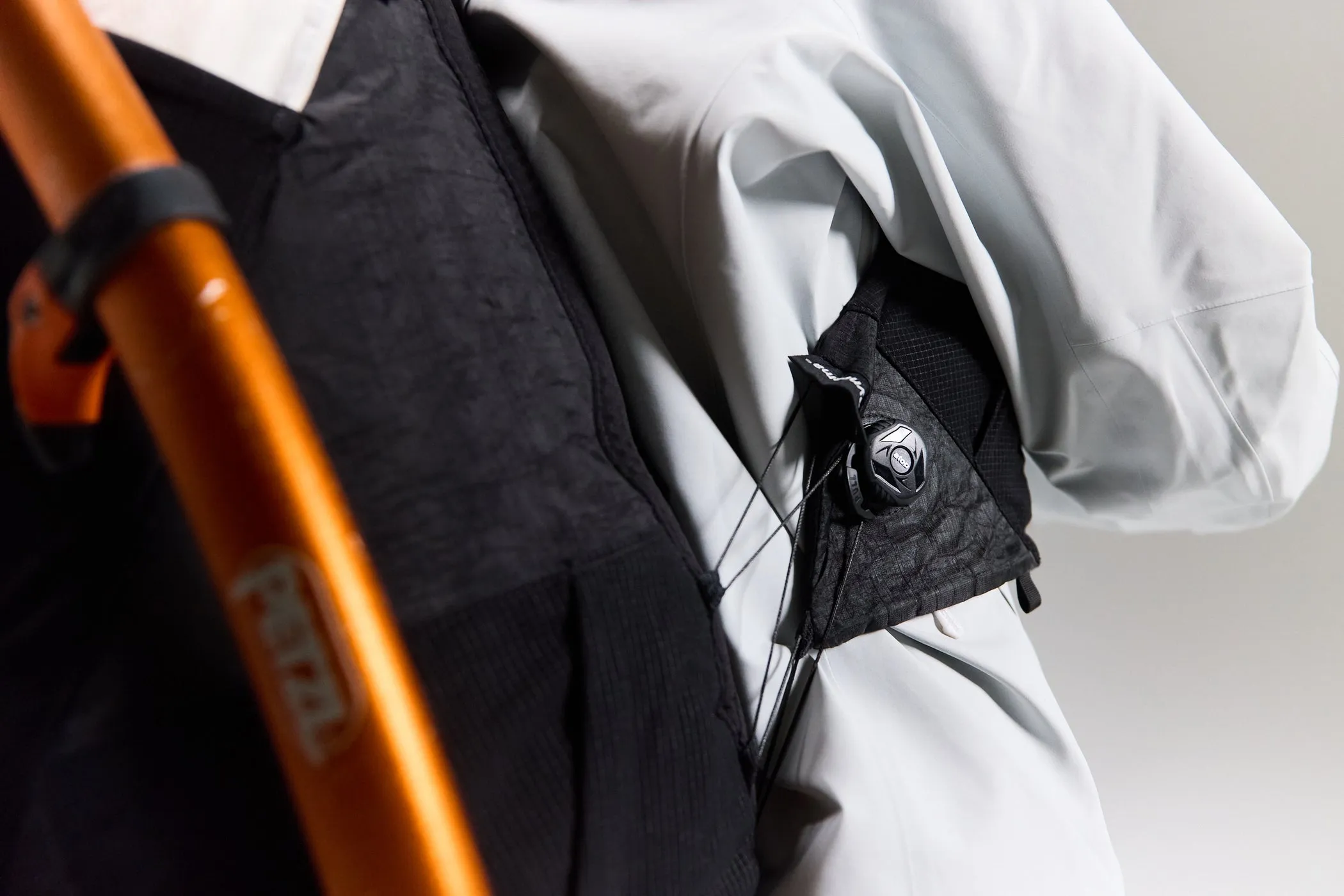
The centrepiece is the vest harness. Samaya uses an Atop® cable dial, rather than a BOA-branded dial, to draw the lower harness around the torso. A rigid sternum strap and a second elastic strap complete the closure. The fit range is based on circumference at the lowest rib rather than conventional back-length torso sizing, making the tester’s measurements and selected size important context for the full review.
What needs to be proven
The specification sheet is convincing. It is not a verdict.
First, the harness has to stay comfortable when the pack carries climbing weight rather than running weight. A litre of water, food, and a shell are one thing; a rope, rack, crampons, and alpine layers are another. The important question is not simply whether the pack can hold them, but whether the vest still distributes that load without creating pressure across the chest or shoulders.
Second, the fit system needs to work through real transitions. The thin tensioning cords that connect the Atop dial to the harness are a particular durability concern. They sit in an exposed position where contact with granite could cause fuzzing, flattening, cuts, or fraying. I want to see whether the cord routing protects them during normal climbing contact, whether repeated abrasion changes how evenly the harness cinches, and whether the dial continues to hold tension. Can the dial also be adjusted with gloves? Does it sit cleanly with a climbing harness and different layers? If the pack is fitted tightly for climbing, can the elastic closure still accommodate heavy breathing on a fast approach?
Third, DCF Hybrid deserves a nuanced test. Its laminate supports a waterproof construction and its polyester face is intended to add abrasion resistance, but neither detail makes the pack immune to wear. Chimneys, rough granite, ski edges, and ice tools are where an ultralight pack reveals its compromises. I will track the base, stretch pockets, cable routing, and attachment points rather than treating the fabric name as a durability conclusion.
Finally, the alpine carry systems need to be more than a checklist. A ski carry must remain stable on steep bootpacks. Ice tools should attach quickly and stay clear of the legs. Skins need to move in and out of the rear pocket without a wrestling match. Each feature should be judged by whether it reduces stops and friction during the day.
How I’ll test it
The field review will focus on climbing stability, carry and fit, access while moving, alpine versatility, and durability in weather. Scores will only be added after there is enough use to defend them.
The summer test will include long granite days in Squamish, sustained technical climbing with the pack left on, and approaches long enough to expose fit or load-distribution problems. I will compare several documented load weights and repeat representative days with the Distance 15 and a conventional alpine pack where practical. The Atop tensioning cords will get their own inspection log, with close photographs before and after routes where the pack rubs against rock. I will record abrasion, fraying, flat spots, cuts, tension loss, and any change in dial operation or how evenly the harness cinches.
The winter update will cover a real ski carry, ice-tool and pole configurations, skin storage, glove use, and repeated wet-snow exposure. Dated photographs will document wear on the base, stretch pockets, cable routing, and attachment points.
The full review will record the exact pack size, body measurement, typical load weights, accessories fitted, days used, distance, and vertical. With a vest-style system, fit is not background information; it is part of the product’s performance.
Who it appears to suit
The Ultra Pace appears most relevant to climbers and ski mountaineers who already pack with discipline. Twenty-plus-three litres is generous compared with a running vest but small compared with a conventional alpine pack. That is an advantage for a fast day and a constraint everywhere else.
It will not replace a load hauler, an overnight pack, or a pack intended for regular hauling against rock. Its promise is narrower and more interesting: meaningful alpine capacity and carry systems in a pack designed to stay close to the body while climbing.
Whether it delivers on that promise will come down to comfort under a real load, abrasion resistance, and the behaviour of those carry systems when the day becomes messy. Those answers belong to the field test.